

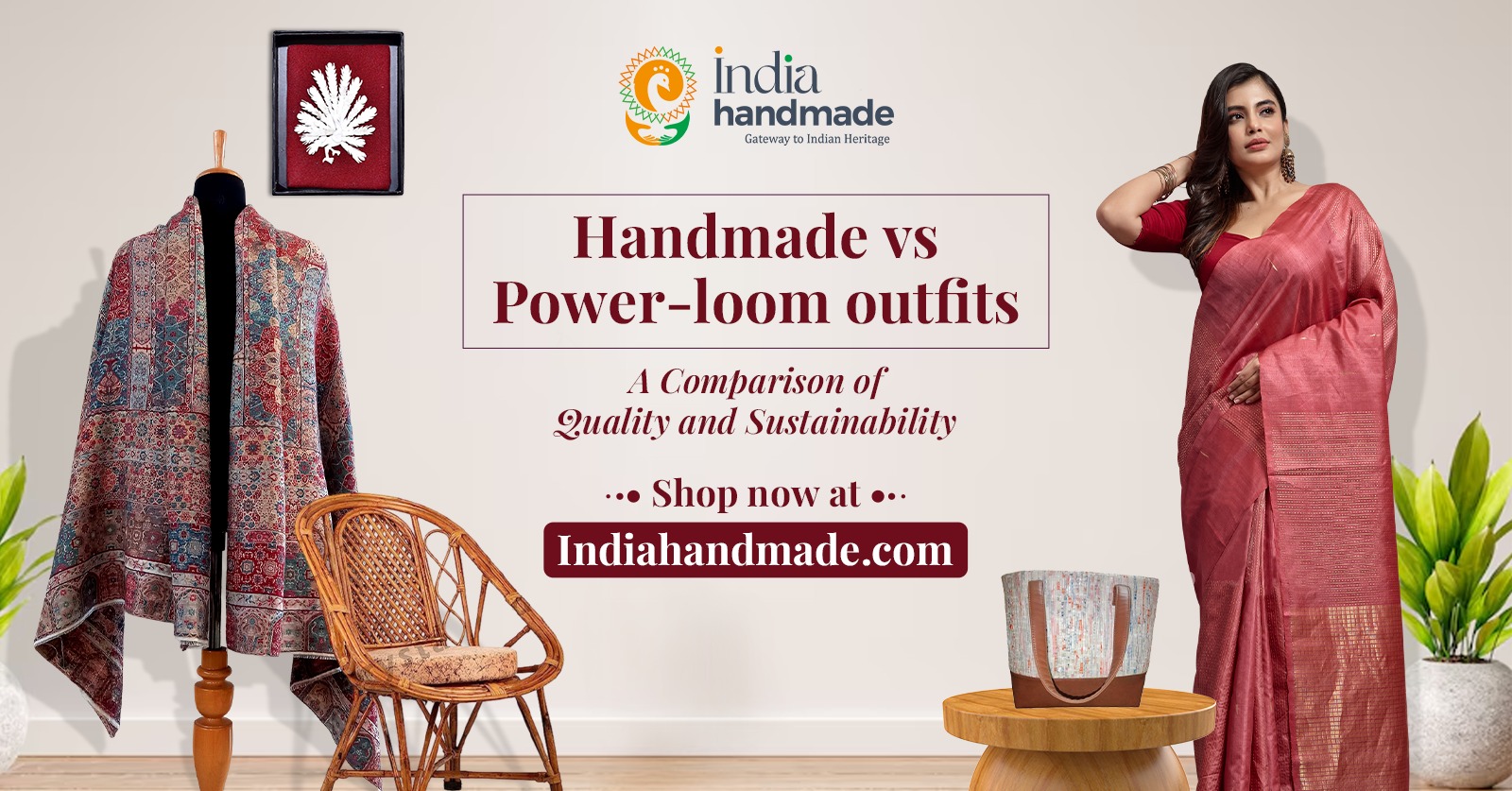
There has been a change in how people perceive fashion over the last few years. People are now opting for ethical, sustainable and conscious fashion rather than speedy and mass-made clothes. Whether to opt for handmade or powerloom clothing is now a widely debated topic. It’s no longer just clothes—it’s now about culture, identity and responsibility.
India boasts a glorious legacy of hand-tailored clothes. From Kanjeevaram to Chikankari, from Pashmina to Bandhani, each province has a tale to tell through its fabrics. On the contrary, powerloom products cater to a fast-paced market. They are fast, inexpensive and readily accessible.
So, are handmade and powerloom garments different? Is one superior to the other in terms of quality and sustainability? Let’s find out.
Understanding Handmade and Powerloom Outfits
Artisans design handmade outfits through traditional processes. These involve hand-spinning, hand-dyeing and hand-weaving. Every garment is created with love, patience and commitment. No two handmade garments are identical.
Powerloom clothing is produced by machines that produce fabric at high speed. These machines can reproduce patterns in a short time and save labour costs. The fabrics produced on powerlooms are uniform, efficient and mass-produced.
Quality: Attention to Detail Vs. Machine Precision
Quality is one of the largest discrepancies between powerloom and handmade clothes. Handmade garments distinguish themselves due to the care exercised by each one. Artisans notice each thread and seam. They implement natural fibres with high standards, like cotton, silk and wool. It becomes a natural, breathable and long-lasting piece of clothing.
Powerloom fabrics, though neat and uniform, sacrifice finesse at times. Machine fabrics can use synthetic blends to cut costs. They can appear flawless on the surface but don’t necessarily last.
For instance, a handwoven cotton saree can get softer and better with every wash. A powerloom saree can lose its texture soon. That is why handmade garments are usually heirloom quality.
Sustainability: Eco-Friendly Vs. Energy-Intensive
Sustainability is not a fad. It’s the requirement of the time. Handmade clothing is sustainable by nature. They consume less electricity and water. Most artisans employ natural colours, which are non-polluting. Because these products are produced in small quantities, they generate less waste.
Powerloom units, however, are power-hungry. They need electricity at all times. The dyes for these fabrics tend to be chemical-based. Garbage from mass production finds its way to pollute rivers and soil.
Furthermore, handcrafted garments promote slow fashion. They are built to last. When you dress handcrafted, you shop less and appreciate more.
Employment: Supporting Artisans Vs. Supporting Machines
The second-largest employment-generating sector in India, after agriculture, is the handmade industry. It consists of weavers, dyers, embroiderers and other skilled artisans.
When you opt for handmade clothes, you are supporting livelihoods. You are supporting rural Indian women, older artisans who have learnt their craft well and young weavers attempting to preserve traditions.
Powerloom industries also provide employment, particularly in industrial regions. But the major work is done by machines. There are fewer skilled jobs.
Being Vocal for Handmade is being vocal for employment. When we say Vocal for Local, then we have to think about our weavers and artisans as well.
Design and Uniqueness: Tradition Vs. Mass Appeal
Hand-knitted clothing usually has a story behind it. Every design holds significance. Each pattern holds the past. For instance, a Banarasi saree can feature nature scenes. A Phulkari dupatta can have elder blessings. There is no machine that can beat this emotional sense.
Powerloom wear is fashion-forward. It does what’s “in trend”. But usually, it is devoid of the soul that handmade clothing possesses.
Uniqueness is not common in powerloom garments. Thousands of identical items overflow the market. With handmade, you are wearing something that nobody else has.
Comfort and Feel: Natural Vs. Synthetic
Most handmade textiles are skin-friendly. They are constructed of natural fibres such as organic cotton, eri silk or khadi. These are ideal for Indian weather. They are sweat-absorbing, breathable and light in texture.
Powerloom fabrics, particularly synthetic-blend ones, cannot be as comfortable. They can cause rashes in summer or cling to the body. Wearing handmade isn’t only a fashion statement. It’s also a healthy choice.
Cultural Preservation: Weaving Identity
Handmade apparel is closely connected to our heritage. Wearing handmade serves to maintain India’s rich traditions. Each region has its own weaving tradition. From Ilkal of Karnataka to Pochampally of Telangana, from Tangail of Bengal to Muga of Assam—these are not pieces of clothing; they are a part of us.
Purchasing handmade is a cultural preservation act. When you wear handmade, you wear India. Powerloom sets lack this depth. Powerloom sets are international in design. They reproduce classic designs but without their essence.
Economics: Cost Vs. Value
Handmade outfits may cost more than powerloom clothes. But there’s a reason. You’re paying for time, skill and tradition. You’re paying for quality and durability. You’re paying for a better future.
Powerloom outfits are cheaper. But they often end up in landfills after a few uses. They promote a throwaway culture. In the long run, handmade clothes give more value for money.
Being Vocal for Handmade and Vocal for Local
The Atmanirbhar Bharat movement is all about being Vocal for Local. The fashion industry is no different. Being Vocal for Handmade is about supporting the dignity of labour. It is about opting for quality over quantity. It is about rejecting fast fashion.
Being vocal for local is about preferring Indian weavers and artisans to foreign brands. It is about returning to roots. Handmade clothing is not mere attire. It is representative of dignity, persistence and innocence.
Where to Buy Handmade Outfits?
If you want to support the artisans directly, go to Indiahandmade.com. Indiahandmade is a government-backed website where artisans and weavers from all over India sell their products. The portal encourages genuine handmade products—from clothing and garments to home furnishings and jewellery.
By shopping at Indiahandmade, you ensure your money reaches the makers directly. You support livelihoods. You support dreams. The platform also guarantees quality checks, reasonable prices and hassle-free delivery.
A Choice That Matters
The handmade vs powerloom debate is not merely a debate about cloth. It’s a debate about the world that we wish to inhabit. Handmade clothing signifies sustainability, culture and society. They are crafted with passion and soul. They are more durable. They have stories.
Powerloom clothing signifies speed and convenience. But at the expense of the environment, jobs and heritage. As consumers, we can determine the course of fashion’s future. Let us make wise decisions. Let us decide on handmade.
Be Vocal for Handmade. Be Vocal for Local. And support the artisans. Purchase handmade products directly from them through Indiahandmade.com.