


Each thread spun on a handloom tells a part of India’s story, which portrays strength, beauty and tradition. From the beautiful Jamdani of West Bengal to the bold Ikat of Telangana, the handloom industry has been the favourite of all. It has given millions a sense of identity, a heritage and a way to make a living. Every year on August 07, the whole country celebrates this rich and lively tradition by observing National Handloom Day.
National Handloom Day reminds us that we all have a duty to protect, promote and support the artisans whose skills are the foundation of India’s textile heritage. As the world becomes more and more mechanised, India’s handwoven traditions become even more important. They offer sustainable alternatives, promote slow fashion and give rural economies more strength.
A Date Rooted in History and National Pride
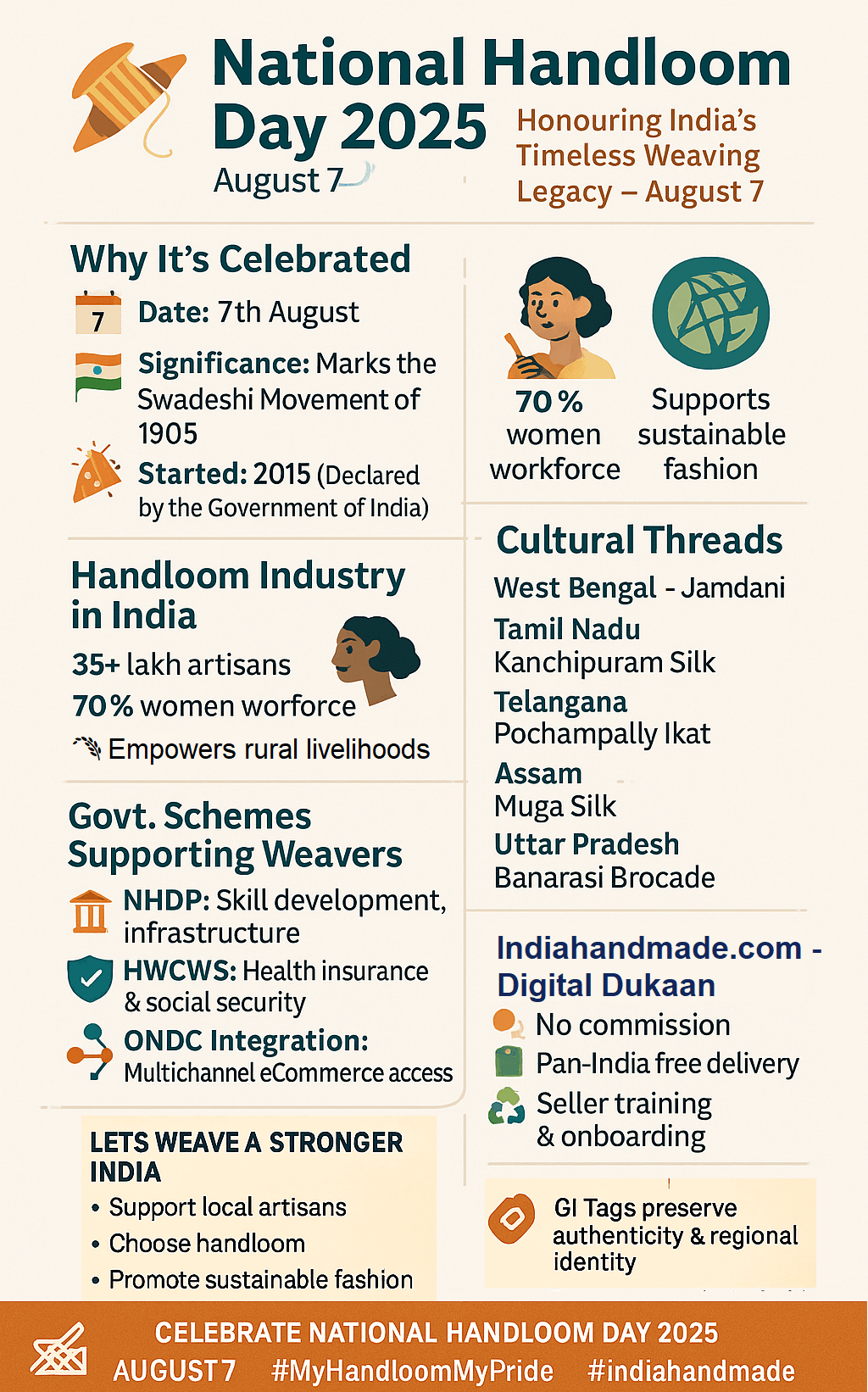
August 07 was chosen to remember the start of the Swadeshi Movement in 1905, which began at the Calcutta Town Hall in response to the British decision to split Bengal. This movement told Indians to stop buying foreign goods and start making things again, with handlooms at the centre of it.
The Indian government officially declared this day “National Handloom Day” in 2015 to raise awareness of how important the handloom industry is to India’s social and economic growth. That year, the first official celebration took place. It showed that the country was still committed to protecting the unique legacy of its handloom sector.
The Cultural and Economic Importance of Handlooms
The handloom industry in India is a living tradition that gives work to more than 35 lakh artisans in India. Women make up more than 70% of these artisans, which makes the sector an important force for women’s empowerment.
The handloom industry shows how diverse India’s culture is, with each area having its own methods, patterns and dyeing styles. Handloom weaving is closely linked to regional identities, from the delicate Chanderi of Madhya Pradesh to the earthy Pochampally of Telangana. As a result, there is a wide range of bright fabrics that are still in demand in both domestic and international markets.
The Government’s Role in Empowering Through Schemes & Policies
The Indian government has been helping the handloom industry through several programs, policies and digital initiatives. The goal is twofold: to protect the artisans’ traditional knowledge and skills and to make their goods sellable, both online and offline.
Some important steps are:
- The National Handloom Development Programme (NHDP) was all about improving infrastructure and giving people new skills.
- The Handloom Weavers’ Comprehensive Welfare Scheme (HWCWS) includes social security, health insurance and access to credit.
- eCommerce Integration: A good number of handloom products are now available online through platforms like Indiahandmade, which helps weavers reach customers outside of their local markets without paying commissions.
Indiahandmade: A Digital Bridge for Weavers of India
Indiahandmade is a government-backed eCommerce platform by the Ministry of Textiles that lets artisans and weavers from all over India showcase and sell their goods directly to customers. This is a big step in the right direction. This platform has more to offer than just a digital store.
- Personalised onboarding help to sellers all over the country, with a focus on rural areas.
- Training sessions both online and in person on how to list products, manage orders and help customers.
- Encouraging weavers to take part in events at well-known places like Handloom Haat, Dilli Haat and other handloom events across India.
- Working with state and local governments on the ground to onboard sellers, making sure that even those who don’t have easy access to the internet don’t get left behind.
Boosting the Awareness Through WhatsApp, ONDC, ODOP & More
Indiahandmade has integrated and collaborated with several modern digital frameworks to make life easier for handloom weavers and artisans all over the country. This is a way to make the ecosystem even stronger.
- ONDC: Indiahandmade connects sellers to a single network of multiple eCommerce platforms through its integration with ONDC (Open Network for Digital Commerce). This greatly increases their reach by getting rid of the need to sign up for each platform separately and eliminating high commissions and onboarding costs.
- ODOP: This program promotes handloom products that are unique to each district and have the potential to be exported. Indiahandmade actively shows off ODOP products from different districts, which helps the best local weaves get attention both in India and around the world.
- WhatsApp Chatbot Integration: Artisans can now self-register, get order notifications, process orders, upload products and inventory, get alerts and notifications and stay in touch with customers in real time on WhatsApp.
How Do GI Tags Help Protect Craftsmanship?
Many handloom products in India have received Geographical Indication (GI) tags. These tags prove where the products came from and that they are authentic. This is very important for preserving the identity and history of regional weaving traditions. Some popular handloom products with GI tags are:
- Banarasi Brocade from Uttar Pradesh
- Muga Silk from Assam
- Kanchipuram Silk from Tamil Nadu
- Baluchari Sarees from West Bengal
- Pochampally Ikat from Telangana
Women at the Forefront of National Handloom Day 2025
Women make up more than 70% of the people who work in the handloom industry. These women are also designers, business owners, community leaders and keepers of tradition.
Many exhibitions and workshops are planned across India for National Handloom Day 2025 to honour their contributions. The events will show how women are turning traditional weaving into a modern business, from live demonstrations to fashion walks with handmade weaves. New Delhi, Varanasi, Hyderabad, Bhubaneswar and Guwahati are some of the cities that are likely to host big events with regional weaves. Activities will include:
- Showcasing rare and endangered weaving techniques.
- Interactive workshops with artisans and designers.
- Buyer-seller meets to strengthen B2B connections.
- Live demonstrations of natural dyeing, spinning and weaving.
Let’s Celebrate the Weaves & Weavers of India
National Handloom Day is a way for the whole country to honour art, patience and pride. It brings the focus back to the simple looms and the many people who work on them. These hands hold centuries of rhythm, memory and knowledge. These are the hands that have shaped India’s textile story and will keep doing so if they get the help they need.
Let’s not stop at showing our appreciation as India celebrates National Handloom Day 2025. Let’s support handloom products, promote fair trade and keep these traditions alive not just in museums but also in our clothes and everyday lives. A saree, a dupatta or even a mat can be a small but significant way to honour one of India’s greatest legacies.
![8 Must-Have Summer Dresses for Your 2026 Capsule Wardrobe [Expert Picks]](https://img.indiahandmade.com/magefan_blog/IMG-20260518-WA0007.jpg)